The course catalog takes on a new meaning
The course catalog, which has long been the backbone of corporate learning, is changing. It's morphing from a static, voluminous library of courses into a more dynamic, personalized experience.
As AI becomes integrated into learning and development, it's helping usher in new ways for people to learn and access information. However, there's more at play.
A tenuous link between training and business priorities is among the main reasons prompting the change.
For many, how they've approached training isn't doing enough. The lack of alignment between business priorities and training means the workforce isn't being prepared to deliver against their organizations' goals.
Those HR and L&D leaders struggling with lackluster results have arrived at both a mandate and opportunity:
The Mandate
Change is inevitable and comes quickly these days. The workforce must be ready for disruption when it happens.
The Opportunity
AI can accelerate curriculum design and move organizations beyond static content libraries toward dynamic learning systems.
Those who prioritize workforce readiness and pivot their learning strategies will close skill gaps quickly, respond to change fluidly, and connect learning to business outcomes directly.
The traditional course catalog must evolve to prepare employees to deliver on business priorities in the face of rapid change.
In other words, the old course catalog is out.
What’s in are dynamic learning systems that deliver timely, relevant training that’s aligned with business needs. These systems combine AI-assisted content creation with internal expertise, skills intelligence, continuous benchmarking, and personalized learning journeys.
Read more about what this change means for those in charge of learning strategy and workforce development.
Skillsoft surveyed 1,000 HR and L&D professionals about their talent development programs, and the findings show that while 85% have an established program, just 20% see them as aligned to business priorities. Only 6% see their programs as "outstanding."
The problem isn't volume, it's speed and relevance to readiness
Largely, organizations don't have a content problem. They have a readiness problem.
After decades of investment, the average enterprise learning library is deep. But leaders aren't just asking for baseline knowledge. They're asking for specific, contextual capability curated for their organization and delivered fast.
Consider what CHROs are navigating right now:
AI adoption programs that need to reach thousands of employees within weeks, not the six-month cycles that custom development usually requires.
By the time training launches, AI has likely evolved. This leaves employees with outdated information and unprepared for what's currently available.
And even when content exists, it rarely arrives assembled in the way the business actually needs it. L&D teams must still identify the right materials, contextualize them for their organization, and build learning paths that connect knowledge to capability.
This creates a preparedness gap. Business strategy moves forward, but workforce capability lags behind.
The consequences are significant.
According to IDC research, 67% of organizations see business transformations delayed because their workforce lacks the skills needed to execute.
AI intensifies the situation
On the other side, it changes how learning happens, compressing the content development cycle from months to days and providing instantaneous answers.
AI solves the speed problem and puts a dent in the cost of content creation. As curriculum designers onboard AI tools and apply them to course design, they can make quick work of refreshing a content library and delivering volumes of high-quality training fast.
From the inside out, organizations are asking a different question:
The strongest compliance programs connect these forces. External requirements set the baseline. Internal values define the standard.
When those align, compliance stops being a constraint and becomes an expression of culture.
But that convergence doesn't happen by accident. It happens when compliance leaders and HR leaders work from the same playbook, aligned on the same priorities and measuring progress against the same outcomes.
In this situation, AI raises the bar for what the workforce needs to know. Leaders expect every function to work with AI in some fashion to speed up their tasks or expand beyond what's in their job description.
On the other side, it changes how learning happens, compressing the content development cycle from months to days and providing instantaneous answers.
AI solves the speed problem and puts a dent in the cost of content creation. As curriculum designers onboard AI tools and apply them to course design, they can make quick work of refreshing a content library and delivering volumes of high-quality training fast.
That's good news for hungry business leaders, who must constantly adapt their strategy. But it's only a part of the solution. To develop an especially agile workforce, a whole system must be created.
AI Literacy for 70,000 Learners in 90 Days
When CGI, one of the world's largest IT services firms, committed $1 billion to expanding its AI capabilities, the company faced an immediate challenge: getting 90,000 employees fluent in responsible AI — fast.
CGI launched a phased AI training program that blended curated Skillsoft content with internally developed materials personalized to CGI's policies, client industries, and individual roles. Within 90 days, 70,000 employees had participated, earning 140,000 completion badges.
Among the CGI employees who participated, 90% reported confidence in applying what they'd learned on the job. CGI called it the most successful non-mandatory learning program in the company's 48-year history.

From content library to learning system
A course catalog answers the question "what can my people learn?"
A learning system answers a harder one: "What can my people learn now, what skills must they learn for the future, and how fast can we close the gap?"
This shift has four components.

Expert content as the foundation
Curated, expert-built content isn't going away. That's still the gold standard and the most efficient way to build foundational knowledge. What changes is its role. Instead of being the entire strategy, expert content becomes the base layer you build on, not where you stop.

Internal knowledge made scalable
Some of the most critical capabilities an organization needs already exist — how your company develops leaders, deploys code, or handles sensitive customer issues. AI-assisted tools make it possible to capture that institutional knowledge, structure it into learning experiences, and share it across the workforce much faster than pre-generative AI days.

AI-assisted creation for speed
When a new AI tool rolls out, you can't wait four months for a custom course. AI-powered content creation compresses the timeline from a business requirement to a structured, interactive program in days, complete with assessments and practice scenarios that reflect your internal systems.

Skills intelligence that connects learning to outcomes
Organizations have spent years measuring learning through completion rates. Those metrics tell you whether people showed up. They don't tell you whether the workforce is ready. A more systematic approach connects learning to skill development, maps skill data against strategic priorities, and gives leaders a clear view of where the gaps are.
What changes for the CHRO
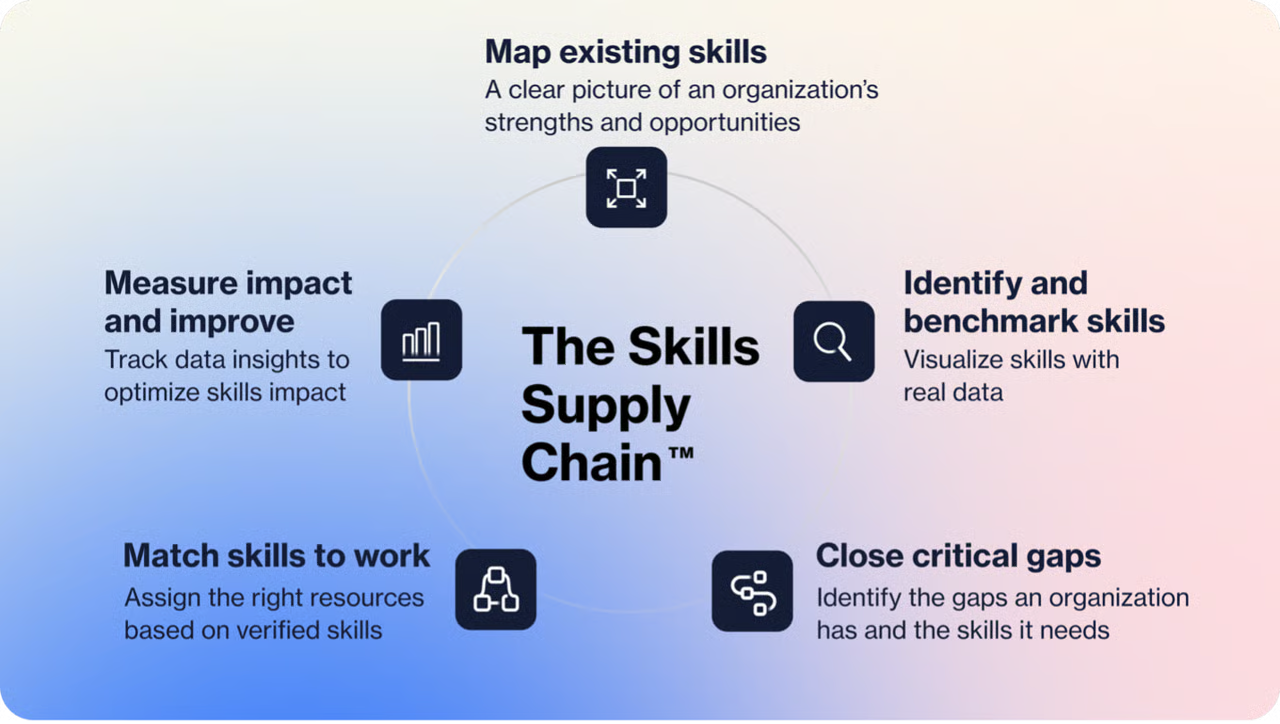
The system that connects these four components is what we at Skillsoft call the Skills Supply Chain™. It’s a framework that clarifies what the workforce is capable of through intentional measurement.
For CHROs, the goal is clear: establish a system that enables the organization to assess capabilities, close skill gaps, and make informed talent decisions.
The framework includes five checkpoints:
For the CHROs, this shifts the conversation around learning.
Speed to capability: AI-powered content creation compresses the cycle from identifying a skill gap to deploying targeted development.
Relevance to the business: Custom content built from internal knowledge and proprietary processes means learning reflects the work.
Evidence for leadership: Skills intelligence provides a single source of truth. The conversation shifts from “how many courses did people complete?” to “are we ready for what’s next?”
Systems integration: Whichever platforms support the greater system, there should be seamless integration among them to allow data to easily flow from one to the other.
Employee experience: When employees receive a personalized learning experience and see their progress, it spurs growth.
“When leaders view talent through a skills management lens, looking at proficiency, potential, and adjacent capabilities, HR and business leaders can build teams aligned to evolving business needs, make more informed growth decisions, and deploy people to projects where their skills will drive measurable outcomes. Over time, this replaces static job descriptions with dynamic, actionable skills data that supports faster decision-making, stronger career pathways, and a workforce model built around outcomes rather than legacy roles.”
Ciara Harrington, Skillsoft CHRO
(Interview with HRO Today)
The course catalog isn’t dead. It’s growing up.
This shift doesn’t require ripping everything out. It requires a thoughtful approach that accounts for what already works and the tools available.
Start by connecting existing systems and identifying a high-priority capability gap. Use AI-powered content creation to develop a targeted program as an early proof of concept. Then scale skills intelligence so leaders gain a clearer view of workforce readiness.
Each phase builds on the last, and the cumulative effect is a learning function that operates at the speed the business requires.
Expert-built, curated content at scale is something organizations will always need. What’s changed isn’t the value of the material, but rather the urgency around readiness.
If what leaders want is a workforce that can adapt as fast as the market, then access to aging content isn’t enough. Leaders need a systematic way to deliver highly relevant content fast, while having a constant read on what the workforce is capable of.
It’s tough to balance with change around every corner, but with the right approach, CHROs and L&D professionals will undoubtedly hit their stride.

Skillsoft’s CHRO Ciara Harrington gave parting advice to her peers in an interview with HR Brew:
“Find a way to take that first step. We’re starting with the leaders, that [might not] be right for every company, but just start somewhere, pick a group, start somewhere, and what you learn, it’s [going to] make it so much easier at that point for you to roll it out more broadly.”
What does this look like for your organization
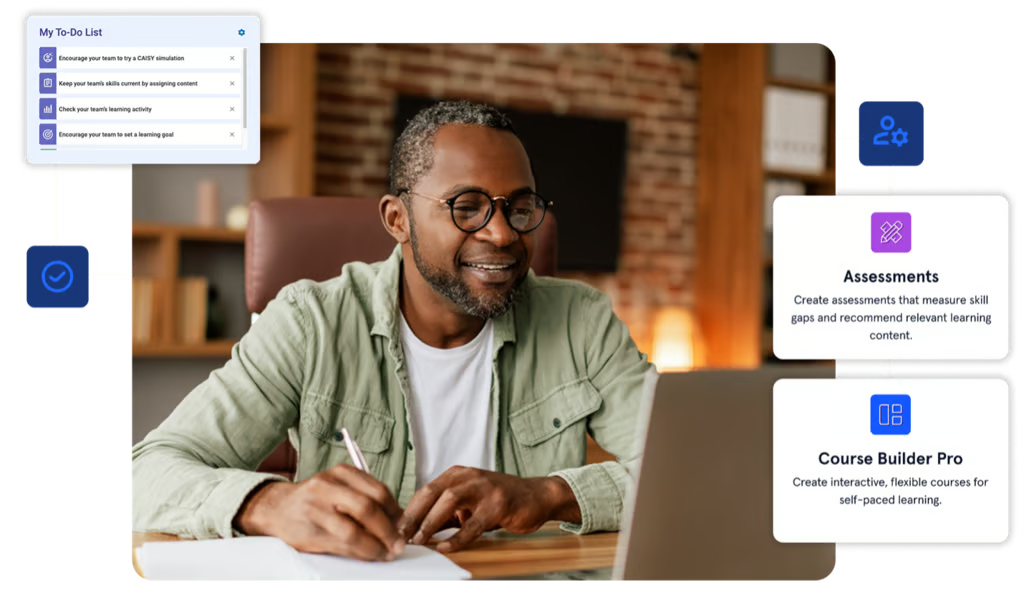
Skillsoft helps enterprises move from fragmented learning tools to a unified skills management system. That includes an extensive course library covering a range of topics, like leadership development, technical skill domains, and compliance. Only, learners experience training differently on the Skillsoft Percipio Platform.
From the very start, the AI-native platform personalizes the experience. Learners’ role, their activity, and their skill proficiency help influence how they find and consume content.
For L&D leaders, you see their progress through extensive dashboards, revealing what skills are available, where gaps are, and the opportunities to quickly ready the workforce.
Visit Skillsoft’s website to request a demo of the Skillsoft Percipio Platform or contact your Skillsoft representative to start the conversation.